

A ta’biya (Arabic: تعبية, plural ta’biyat) is a battle formation — a specific arrangement of pieces that a player aims to reach before engaging. In Shatranj, the medieval Arabic form of chess that succeeded Chaturanga, the ta’biyat were the formal body of opening theory. Sixteen of them were named and documented in manuscripts from the 9th and 10th centuries.
The Masters Who Documented Them
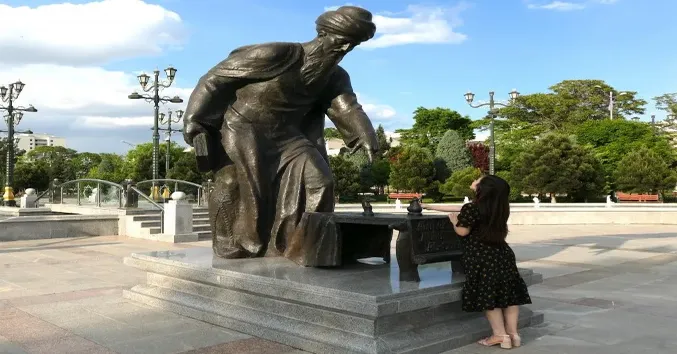
Three names dominate the surviving manuscripts. Al-Adlī (fl. early 9th century) was the first to compile a systematic collection of openings, end-game positions, and composed problems. He was considered the strongest player of his time. Al-Suli (854–946) surpassed him and remained the benchmark for mastery for centuries. Al-Lajlāj (“the stammerer”, fl. 10th century) built on both and produced what H.J.R. Murray — writing in A History of Chess (Oxford, 1913), the source for much of what follows — calls the most technically rigorous treatment of the Shatranj opening.
Murray worked from at least three manuscripts: AH (the oldest and most authoritative), BM (British Museum), and Man. (Manchester). Where they disagreed — and they often did, particularly on exact move counts — he took AH as primary.
The sixteen ta’biyat appear in al-Adlī’s work and are repeated, with commentary, by al-Suli and al-Lajlāj. Their level of agreement and disagreement is itself informative. Al-Suli, writing about eight of the formations he retained, is frank about their relative merit. His highest praise goes to two: “None of the openings given by al-‘Adlī are better than these two, al-mujannah and as-sayyāla.” His lowest assessment also singles out two: “Of these eight openings none are weaker than these two, al-mu’aqrab and al-masha’khī, and yet I consider them better than the remaining openings which al-‘Adlī gave and which I omit.” He retained those weaker two because he judged them still superior to the formations he dropped entirely.
How They Were Meant to Be Used
The ta’biyat are sometimes described as fixed recipes — play these moves and you have the opening. That is not quite right.
Murray quotes directly from the manuscripts on this point: “These openings are not diagrammed thus because one opposes the other. One should strive in every opening to play according to what is necessary, and to observe the play of the opponent.”
The formation is a goal, not a script. You strive toward it, but you respond to what the opponent does. Al-Lajlāj elsewhere notes that a skilled player can abandon his chosen opening if the opponent gives him an advantage — the formation is a default, not a constraint. What the manuscripts document is the completed position that represents sound development, not a forced sequence of moves.
This is the same concept modern chess theory uses for a “tabiya” (the word passed into modern usage directly from Arabic). In the Ruy Lopez or the Sicilian Najdorf, there is a characteristic position that both sides are trying to reach. The move order is somewhat flexible; the structure is what matters.
The Sixteen Formations
The full list, with Murray’s move counts:
| # | Arabic Name | Translation | Moves | Opening Sequence |
|---|---|---|---|---|
| 1 | Waṭad al-anz | The Goat-Peg | 16 | 1.d3 2.Af3 3.c3 4.g3 5.e3 |
| 2 | Muraddad | Moved To and Fro | 19 | 1.b3 2.Ra2 3.a3 (Ra swings) |
| 3 | Hiṣn fir’aunu | Pharaoh’s Fortress | 19 | 1.c3 2.Ge3 3.Af3 4.b3 5.d3 |
| 4 | ’Aja’iz | The Old Women | 19 | 1.h3 2.g3 3.Af3 4.c3 5.b3 |
| 5 | Mujannah | The Flanked | 12 | 1.f3 2.f4 3.Af3 4.g3 5.c3 6.c4 7.Ac3 8.b3 9.d3 10.a3 11.Rb1 12.Rg1 |
| 6 | Sayyāla | The Torrent | 12 | 1.e3 2.e4 3.Af3 4.d3 5.c3 6.b3 7.Ac3 8.g3 9.f3 10.a3 11.Rb1 12.Rg1 |
| 7 | Masha’ikhi | The Sheikh’s Opening | 19 | 1.a3 2.Ra2 3.h3 4.b3 (vs Mujannah) |
| 8 | Mu’aqrab | The Strongly Built | 19 | 1.Ac3 2.b3 3.d3 4.Ge3 5.Gh3 |
| 9 | Saif | The Sword | 19 | 1.d3 2.d4 3.d5 (sword thrust after formation) |
| 10 | Band al-khadam | The Slave’s Banner | 18 | 1.a3 2.b3 3.Ra2 4.Rb2 5.d3 |
| 11 | Jaish | The Army | 20 | 1.Ge3 2.Gh3 3.Af3 4.Ac3 5.d3 6.e3 |
| 12 | Raqu’ūqi | (meaning unknown to al-Sūlī) | 8 | 1.Af3 2.g3 3.Ac3 4.b3 |
| 13 | ’Ibs | The Shoulder | 5 | 1.g3 2.Af3 3.c3 |
| 14 | Kirmānī | Of Kirmān, a Province of Persia | 19 | 1.Ge3 2.Gc5 3.d3 4.Af3 5.c3 |
| 15 | Muwashabah | The Richly Girded | 17 | 1.Gh3 2.g3 3.Af3 4.f3 5.c3 |
| 16 | Mutalahiq | The Conjoined | 16 | 1.Ga3 2.a3 3.b3 4.Ac3 5.d3 |
The Mujannah and Sayyāla stand apart: both achieve complete piece development in twelve moves. Al-Lajlāj says of the Mujannah: “It is the only one of the Openings in which all the pieces are moved in twelve moves.” This is the reason they carry the highest weight in the engine’s opening book.
The four shortest formations — Raqu’ūqi (8 moves), ‘Ibs (5 moves), Mujannah and Sayyāla (12 moves each) — complete development quickly. The longer formations, running to 18–20 moves, were more committed.
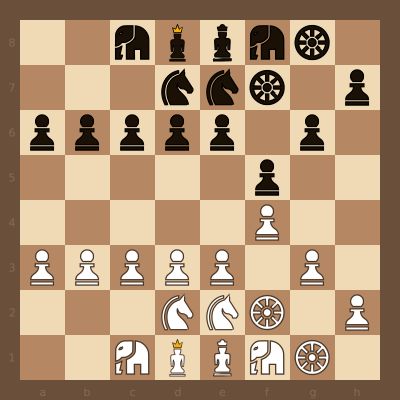
Boards below show the completed ta’biya position. Click any board to play from that formation against the engine.
1. Waṭad al-anz — The Goat-Peg
System 1 · 16 moves
Jābir used to begin with it, and after him Ibn Rabrab. It is a good opening which requires skill, and is a strong defence. Given by both al-‘Adlī and al-Sūlī.
2. Muraddad — Moved To and Fro
System 14 · 19 moves
Called muraddad from the repeated moves. Jābir used to begin with it, and after him Ibn Rabrab. It is a good opening which requires skill, and is a strong defence. Given by both al-‘Adlī and al-Sūlī.
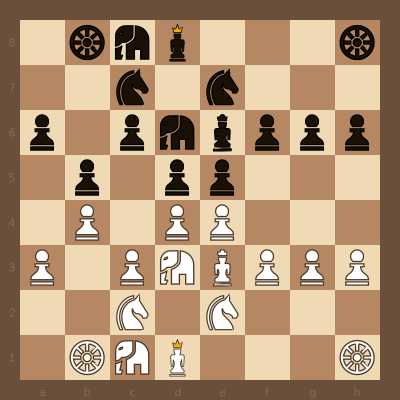
3. Hiṣn fir’aunu — Pharaoh’s Fortress
System 5 · 19 moves · c-pawn chain with early Gaja development
Hiṣn means fortress or castle — “Pharaoh’s Fortress,” named for its great strength. Abū’l-Bain played it. Given by both al-‘Adlī and al-Sūlī.
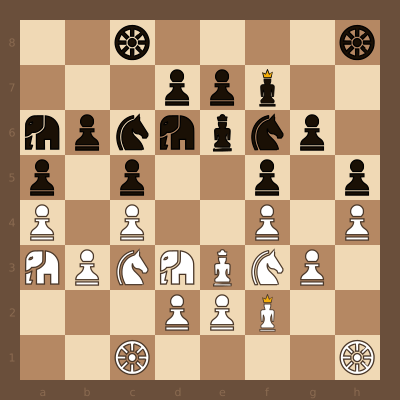
4. ‘Aja’iz — The Old Women
System 12 · 19 moves · h3+g3 pawn formation
‘Aja’iz means “the old women.” ‘Uqda used to begin with it. Given by both al-‘Adlī and al-Sūlī.
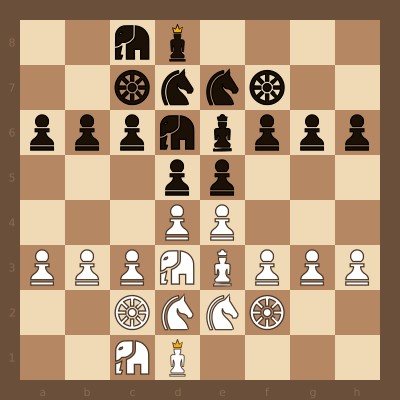
5. Mujannah — The Flanked ✦
System 6 · 12 moves · Al-Lajlāj’s masterwork
The strongest of the named formations. Al-Lajlāj: “It is the only one of the Openings in which all the pieces are moved in twelve moves.” The f-pawn opens first; both sides reach a symmetrical formation with all pieces mobilised in twelve paired moves.
Murray notes that al-Lajlāj gives three plans after reaching the Mujannah, in order of preference: advance the h- and g-pawns on the king’s wing (best), advance the d-pawn centrally (second), advance the a- and b-pawns (worst). The plans are strategic, not tactical — the exact sequence depends on what the opponent does.
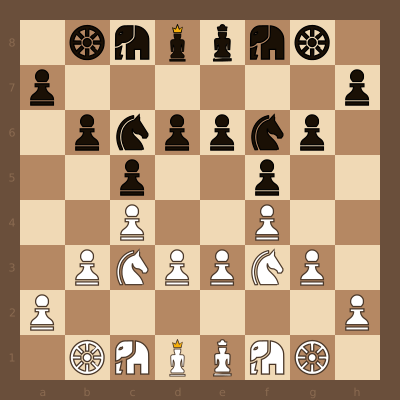
6. Sayyāla — The Torrent
System 2 · 12 moves
Abū Sharara the elder used to begin with it. Al-Sūlī: “None of the openings given by al-‘Adlī are better than these two, al-mujannah and as-sayyāla.” Equal in development efficiency to the Mujannah — all pieces mobilised in twelve moves. Given by both al-‘Adlī and al-Sūlī.
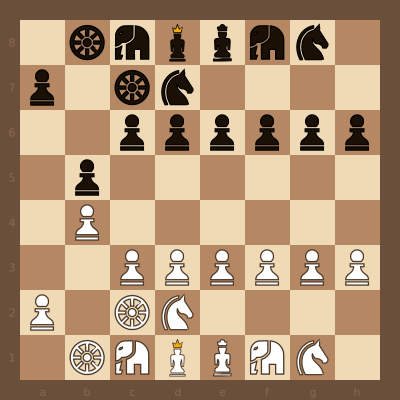
7. Masha’ikhi — The Sheikh’s Opening
System 11 · 19 moves · a-pawn step, ratha swing to rank 2
Na’im used to begin with it. Given by both al-‘Adlī and al-Sūlī. Al-Sūlī rates it the weakest of the eight formations he retained, together with al-mu’aqrab — yet he considered them both superior to the six al-‘Adlī formations he omitted entirely. Al-Lajlāj’s appendix analyses it in depth as the main counter to the Mujannah.
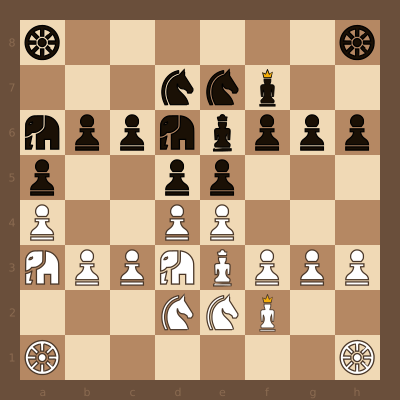
8. Mu’aqrab — The Strongly Built
System 4 · 19 moves · Queenside development
Mu’aqrab means “the strongly built” — not “scorpion.” Fam al-Ḥāt used to begin with it. Given by both al-‘Adlī and al-Sūlī. Al-Sūlī rates it the weakest of the eight formations he retained, together with al-masha’khī — yet he considered them both superior to the six al-‘Adlī formations he omitted entirely.
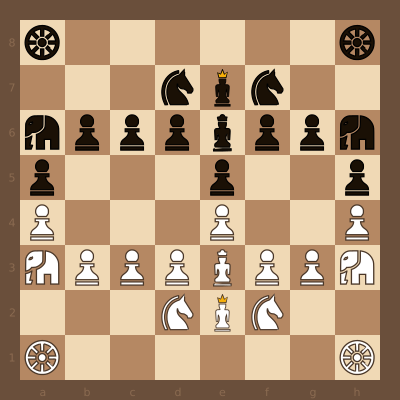
9. Saif — The Sword
System 1 sub-variant · 19 moves · d-pawn sword thrust
Na’im al-Khādūn used to begin with it. The advanced d-pawn is the Saif (sword): after a standard central setup, the d-pawn advances d3→d4→d5, cutting into the enemy position. Al-Lajlāj’s appendix notes: “The player who adopts the Saif can only establish it against the Mujannah if the player who adopts the latter Opening makes a mistake.” Given by al-‘Adlī; omitted by al-Sūlī (AH attributes it to al-Sūlī in error, per Murray’s collation).
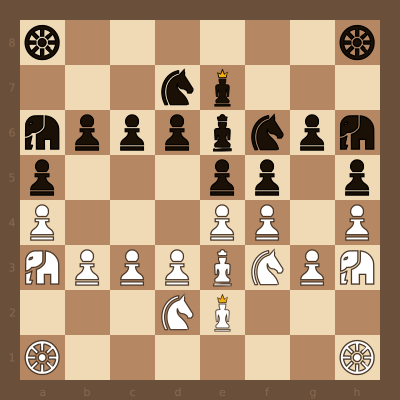
10. Band al-khadam — The Slave’s Banner
System 11 sub-variant · 18 moves
Given by al-‘Adlī; omitted by al-Sūlī.
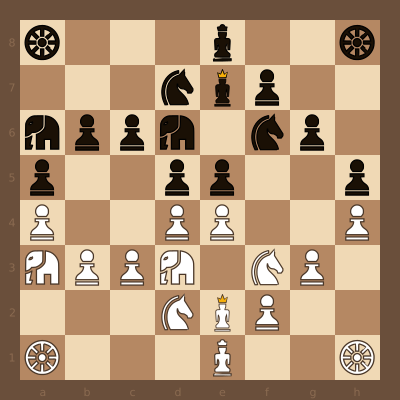
11. Jaish — The Army
System 7 sub-variant · 20 moves
With which people used to begin. Given by al-‘Adlī; omitted by al-Sūlī.
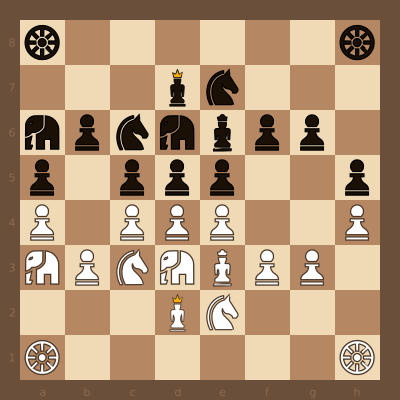
12. Raqu’ūqi
System 3 · 8 moves
Al-Sūlī wrote: “I have never heard to what it refers” — the name’s meaning was unknown even to him. Given by al-‘Adlī; omitted by al-Sūlī.
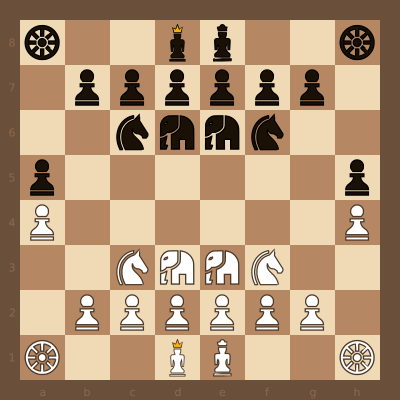
13. ‘Ibs
System 13 · 5 moves · Briefest formation
Al-‘ibt means “the shoulder.” Abū Sharara the younger played it. Given by al-‘Adlī; omitted by al-Sūlī. The shortest formation of all at five moves.
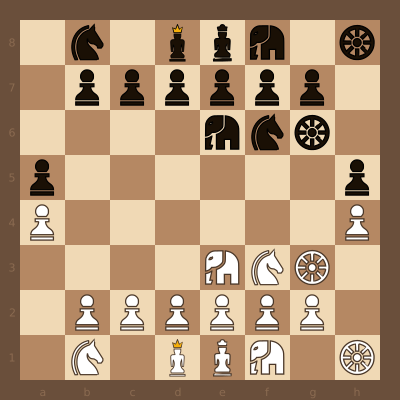
14. Kirmānī — Of Kirmān, a Province of Persia
System 7 · 19 moves
Named for the province of Kirmān, Persia. ‘Omar b. Tā’ūn played it. Given by al-‘Adlī; omitted by al-Sūlī.
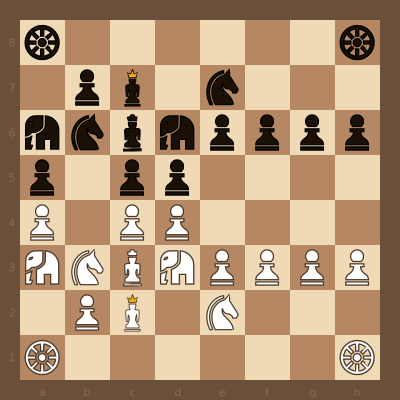
15. Muwashabah — The Richly Girded
System 9 · 17 moves · Kingside Gaja deployment
Al-muwashabah means “the richly girded.” Al-Sūlī himself chose this opening — it is one of the two formations special to him, not given by al-‘Adlī. Murray translates al-Sūlī: “I chose this opening.” The kingside Gaja deploys first (Gf1→h3).
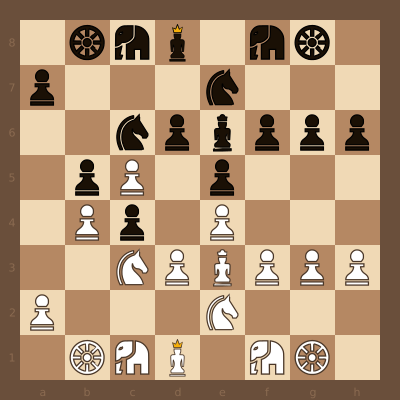
16. Mutalahiq — The Conjoined
System 10 · 16 moves · Connected piece formation
Al-Sūlī himself created and named this opening — it is one of the two formations special to him, not given by al-‘Adlī. Murray translates al-Sūlī: “I chose this opening, and I name it al-mutalahiq (the conjoined), because the pieces disposed one another.” The queenside Gaja deploys to a3 (Gc1→a3).
The Engine’s Opening Book
The Chaturanga engine uses all sixteen formations as a weighted opening book. Each system is represented as a tree of moves, branching at each ply to cover the main opponent responses. The Mujannah and Sayyāla carry the highest weights (4 and 3 respectively), consistent with al-Lajlāj’s assessment of them as the strongest formations. The engine probes the book before searching — at difficulty levels 1–2 it occasionally deviates to add variety; at levels 3 and above it follows the book faithfully while the position remains in the tree.
The book covers roughly six to eight moves of the most critical lines, after which the engine’s own evaluation (material, piece-square tables, pawn structure, king safety) takes over. At that point the engine aims naturally toward sound development — the same structures the ta’biyat describe — because the evaluation penalises the same mistakes the old masters warned against: immobilised pieces, weak pawns, and premature attacks.
Twelve of the formations are encoded as dedicated first-move systems. The remaining four — Saif, ‘Aja’iz, Band al-khadam, and Jaish — are implemented as sub-variants branching from a shared parent system.
A Note on the Sources
Murray’s account of the ta’biyat draws primarily from manuscript AH, which he takes as the most authoritative. BM and Man. sometimes give different positions for the same formation, different move counts, or different names. Murray notes in several places that the writer of BM appears to have made unintelligent use of al-Lajlāj’s work — copying diagrams without understanding the accompanying text. Where manuscripts disagreed on exact positions, Murray re-derived the positions from the described move sequences.
The move counts in the table above are Murray’s counts from AH. They differ in some cases from what BM gives. The important thing, as Murray emphasises, is not the exact sequence but the final structure: the formation is what matters, not the road taken to reach it.