Murray’s A History of Chess (Oxford, 1913) is the kind of book that punishes skimming. Chapter XV covers the theory and practice of Shatranj in about forty pages, and somewhere around page 267 he says something that stopped me:
“The knowledge of these decisions was one of the distinctive marks of the master of the first rank.”
He’s talking about drawn positions. The qawā’im — from a root meaning something like “equal standing.” Al-‘Adlī, one of the great early masters, divided his entire collection of composed positions into three categories: maqhlūbāt (wins), qawā’im (draws), and maqrūfāt (bare king wins). He wasn’t tagging draws as an afterthought. They were a third of the taxonomy.
And then Murray explains how the decisions in the manuscripts were “given without justification.” Just verdicts. You were expected to know whether a position was drawn. If you didn’t know, you weren’t a master. If you didn’t know, the manuscript had nothing to say to you.
There are four kinds of draws in the historical sources. The first two are familiar to any chess player: perpetual check and repetition of moves. Murray cites specific composed positions that demonstrate both. They were known, named, and attributed. The masters could construct perpetual-check positions as puzzles. They considered this normal.
The third kind — mutual baring — is one we have now implemented. The fourth took me longest to see clearly.
The Draw That Shouldn’t Exist
In almost every version of Chaturanga and Shatranj, stripping the opponent down to a bare Raja is a win. Not checkmate — not a threat. An actual, immediate, decisive win. The moment you capture the last enemy piece, you have won the game. This is the rule that makes Chaturanga different from chess. Checkmate matters, but so does annihilation.
Which makes mutual baring an extraordinary exception.
The rule is this: if the bared side — the side who just lost their last non-Raja piece — can respond by immediately baring the opponent’s Raja on the very next move, the game is a draw. Not a loss. A draw. Both armies end up with only their Rajas, and neither claim stands. Murray documents this explicitly in Chapter XV: it is attested across multiple manuscripts and attributed to several masters, including aṣ-Ṣūlī himself, who made it the basis of one of his most celebrated composed problems.
What makes this remarkable is not the rule itself, but how narrow it is. The bared side does not get to survive and fight on. They do not get to win on material. They get exactly one chance: if, on the immediate next move, they can bare the opponent’s Raja, it is a draw. One move. One response. That is the entire window.
No other major chess tradition has this rule. Modern chess has no baring rule at all — the bare king is simply a target that must be checkmated. FIDE insufficient material is based on piece geometry, not the act of stripping. The mutual baring draw is an artifact of a game built around total annihilation, where even the act of being annihilated can, in precisely the right moment, produce a tie.
Implementing it correctly required care. When we detect that a player has been bared, we do not immediately end the game. Instead we walk every legal reply for the bared side and check whether any of them captures the opponent’s last non-Raja piece — and crucially, whether that capture itself results in a win for the bared side or another mutual bare. Only a true mutual bare counts; a move that results in immediate re-capture or exposes the surviving piece to instant recapture is not sufficient.
Al-Suli’s Diamond: Evidence in the Endgame
The strongest historical evidence for mutual baring as a distinct and understood draw condition is not a textual description — it is a composed problem.
Abū Bakr Muḥammad ibn Yaḥyā aṣ-Ṣūlī was secretary to the Abbasid caliphs al-Muktafī and al-Muqtadir. He was also, by consensus of the manuscripts, the greatest Shatranj player of his age. His name appears more often in the draw-rule discussions than any other master. He did not just play the game — he composed problems specifically designed to demonstrate the subtleties of its rules.
The Manṣūba al-Ṣūlī — Al-Suli’s Diamond — is one such problem.
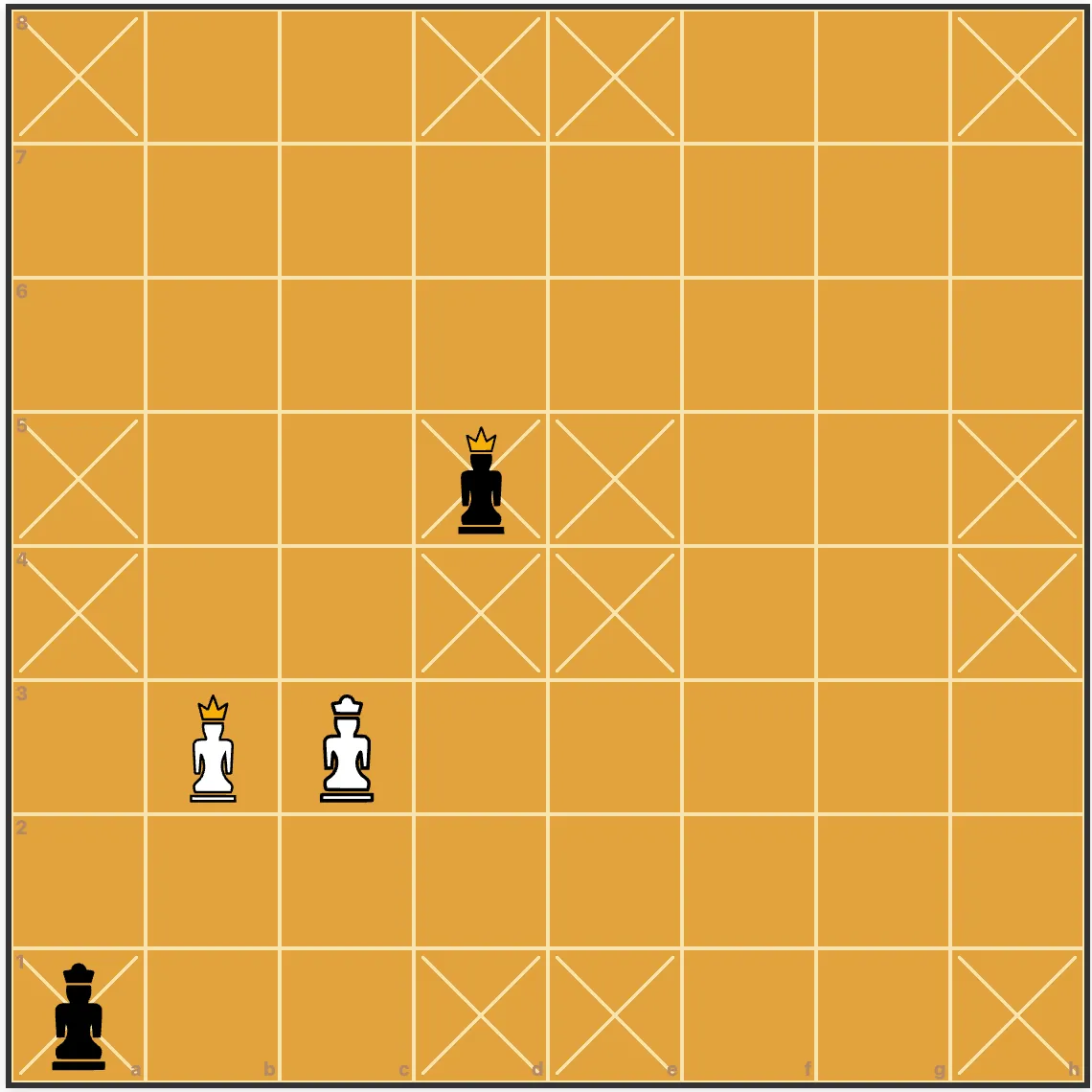
The position: White has a Raja (b3) and a Mantri (c3). Black has a Raja (d5) and a Mantri (a1). White to move and win.
At first glance this looks like a sterile endgame. Two pieces each. The kind of position where modern engines declare a draw within seconds. But it is not a draw. It is a forced win for White in 39 moves, navigating around the exact mutual-baring traps that would otherwise save Black.
The problem was almost certainly composed to illustrate the mutual baring draw rule — to show a student the positions that look like they should produce mutual bare but don’t, and to demonstrate the narrow path White must walk to win cleanly. The Mantri’s diagonal geometry constrains both sides. White’s Mantri and Black’s Mantri operate on different colour complexes depending on where they stand. The forced line requires White to drive Black’s Mantri into a corner while keeping the Raja coordination tight enough that Black’s baring attempts — and there are several — all fail.
You can explore the full solution at Al-Suli’s Diamond. Our retrograde tablebase confirms the position: White wins, distance to mate 39 plies, no drawing line available to Black. Every mutual baring trap in the solution is navigated exactly.
The fact that this problem was composed, preserved across multiple manuscripts, and attributed to the most celebrated master of the era is the clearest evidence we have that mutual baring was not an edge case the masters stumbled over. It was a known feature of the game — precise enough to build composed problems around, and important enough that the greatest player of the 10th century put his name on one.
The Firzan — what we now call the Mantri, the piece that moves one square diagonally — can only ever stand on squares of one colour. If it starts on a light square, it will spend its entire life on light squares. That’s thirty-two of the board’s sixty-four.
The Fil — the Gaja in our notation, the piece that jumps exactly two diagonally — is even more constrained. From any given starting square, it can reach only eight squares on the entire board. Eight. Not thirty-two. Eight.
Now imagine you have six Mantrīs to your opponent’s one. You should win easily. Except your Mantrīs started on light squares and their king is hiding on dark ones. Your Fils started on squares whose modular geometry puts them in a completely parallel universe from the opposing Fils. Your force cannot reach the opposing king. You cannot strip him bare. You cannot win.
Murray puts it plainly: “a player with a great preponderance of force might be quite impotent for purposes of attack.” He gives a diagram: Black has six more Mantrīs than White and cannot touch a single White piece. Drawn game.
This is not an edge case. This is a structural feature of the board geometry that the masters were expected to understand and that ordinary players, apparently, just walked into.
Perhaps another reason this might sound strange to modern players is the visual difference between boards. On an ashtapada — the traditional Indian board — alternating colours do not exist. The geometry is hidden. On a chessboard, it jumps out immediately.
The section I keep returning to is the one where Murray describes the masters’ disagreements.
Even among al-‘Adlī, aṣ-Ṣūlī, ar-Rāzī, and al-Lajlāj — the great names, the ones who wrote the manṣūbāt collections — there are positions where the manuscripts note different authorities gave different verdicts. “A win, but some say a draw.” “A draw, but some say a win.” The reader is invited to consult both sides and decide.
Murray’s description is unsentimental: the drawn-game sections present “a mere collection of decisions, rulings, or opinions, apparently more or less haphazard in origin, which are repeated with but little variation from one work to another.”
I find this comforting and unsettling in equal measure. Comforting because even the masters weren’t always certain. Unsettling because my earlier confidence — that I understood the draw situation well enough to explain our implementation — was exactly the kind of confidence that Murray is quietly describing: someone who had memorised enough to argue, but not enough to be right.
So where does that leave Chaturanga as a game?
I implemented draws not by design. I initially played pure FENs on a CLI, testing the engine in isolation. When the time came to think seriously about draws, I was no longer in the mood to touch the engine. So I implemented the simplest two: threefold repetition, which the manuscripts attest directly, and draw by agreement for PvP games, where both players can offer and accept.
Those two are live. The third — material-impossibility detection — is not.
I think with some effort it is possible. But I am lazy. And I am genuinely unsure how many of the “given without justification” draws in the manuscripts would require me to search to arbitrary depth to confirm. It is not merely a question of computation. It is also a question of whether the problem is interesting enough to be worth solving. Detecting that your Mantri cannot reach the opponent’s king because of colour geometry, accounting for the Gaja’s eight-square universe, tracing what your remaining forces can and cannot cover — this is different from modern FIDE insufficient-material detection. It requires careful engine work, not a rule lookup.
So I will remain the player who has learned enough to argue, and not enough to be right. I am at peace with this, for now.
The historically grounded path, is:
- Threefold repetition (already implemented — attested directly in the manuscripts)
- Draw by agreement (already implemented — both players can offer mid-game in PvP)
- Mutual baring (now implemented — the Manṣūba al-Ṣūlī case: bared side can immediately bare the opponent in reply → draw)
- Material-impossibility detection based on piece geometry (the hardest, and the most important — not yet implemented)
- Draw-by-agreement for PvC (already implemented — this isn’t by material impossibility, but more grounded on how much more boring a win is)
- No fifty-move rule (there is no concept of a half move clock with no Shatranj parallel)
- Stalemate remains a win (already correct)
Based on H. J. R. Murray, A History of Chess (Oxford, 1913), Chapter XV, pp. 265–283.