



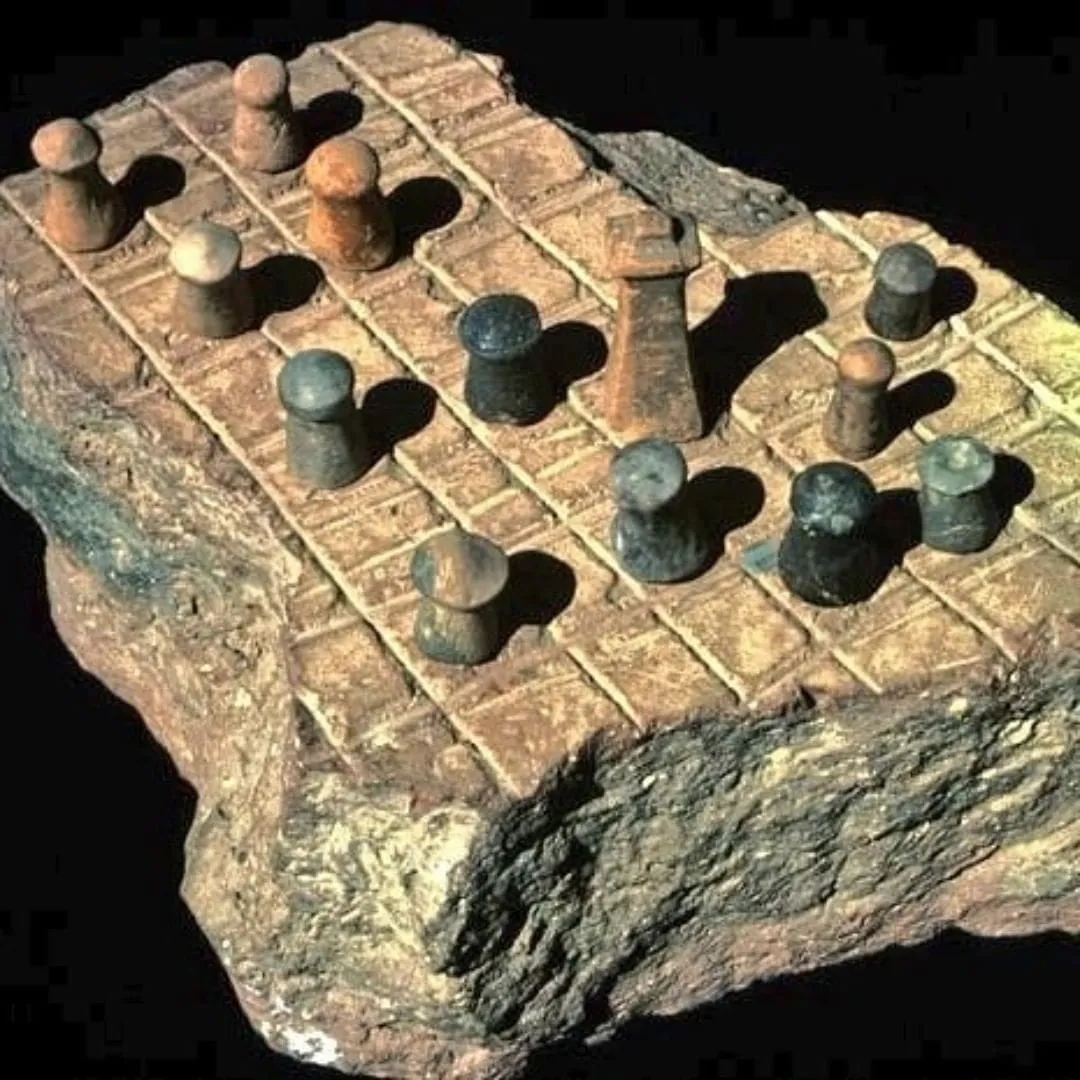
The earliest known chessboard. The pieces are still on it. The wager is not recorded.
In every tradition that took chess seriously, someone was composing problems almost immediately. Not as teaching tools. Not as recreational curiosities. As gambling instruments. The composed position — a board set up in a specific configuration, usually with one side in deep trouble, always with a winning sequence hidden inside — was the primary vehicle for demonstrating mastery. And mastery was worth money.
The Vilas Mani Manjari, the 1928 Kolhapur manuscript we covered in the previous article, is at its core a collection of these problems. The editors published it as a chess textbook. But its skeleton — the thing it was built around — is 21 composed positions in Sanskrit verse, each one designed to be wagered on. The word for them is Daav.
What Is a Daav? §
डाव (Daav, D as in Dude) means, literally, a stake — the thing you put up in a bet. The same word is used in Marathi for any wager. When you set up a composed chess position and offered it to a weaker player, you were offering them a Daav: here is the board, here are the pieces, here is the wager. Solve this and you win. Fail and you lose.
This is not metaphor. Staunton, writing in 1849 and quoted in the Vilas Mani Manjari’s introduction, described the practice directly:
“The felicity displayed by Oriental players at the invention of these odds and their extraordinary skill in solving them… Chess-playing in India reached a height of excellence, which if equalled in modern times has never been surpassed.”1
He is talking about the odds tradition: stronger players gave their opponents a piece advantage — rook odds, knight odds, pawn odds — and set up problem positions from that compromised starting point. The Daav was the instrument of this tradition. A master could carry a dozen composed positions in his head and offer them on the spot. The positions travelled by being memorised, which is why they were written in verse.
At some point the tradition formalised, then faded. The Vilas Mani Manjari records the turn: “after once chess had been abolished in the regulation of the game” — meaning after formal competition had displaced gambling — the odds tradition naturally contracted. “No long time would elapse before the game of giving odds between competent players became rare.”2 The Kolhapur editors were writing down a tradition that had already largely stopped being practised. They were doing archaeology.
The Puzzle as Verse §
Every Daav in the Vilas Mani Manjari follows the same structure.3 First, a Sanskrit shloka — a two-line verse in the classical anushtubh metre, 32 syllables, eight per quarter. The verse encodes the position: which pieces are on which squares. Then a diagram of the board. Then the solution.
The verse was the mnemonic. You didn’t memorise a diagram — diagrams are hard to carry in your head. You memorised the verse, the way you memorised scripture. The rhythm told you where the pieces were. A player who knew fifty Daavs by heart had fifty weapons he could deploy at any moment, in any teashop, against any challenger.
Each problem page carries three labels:
- बारका (Barka) — the challenger; the side to move; always given the winning line. White.
- जादा (Jada) — the defender. The word jada means heavy, inert, weighed down. The defender sits in the position like dead weight. Black.
- सव्या (Savya) — the move count. How many moves the solution requires.
And almost every solution in the collection ends the same way: “प्यादी होणार” — the pawn will queen.4
This is not coincidence. Pawn promotion was the hardest technique to demonstrate under pressure. The Daav tradition systematically drilled the one endgame skill that required exact calculation across the most moves: the passed pawn, marching. You could be careless in the middlegame and survive. You could not be careless with a passed pawn and a hostile king two files away.
Daav and Mansuba §
In the Arabic tradition, the composed problem is called منصوبة (manṣūba), plural manṣūbāt. The root is naṣaba: to set up, to erect, to arrange. A manṣūba is a position that has been set up — deliberately constructed rather than arising from play.
The Daav and the mansuba are the same thing with different etymologies. Both are positions composed for study and competition. Both circulated among masters. Both were used as gambling instruments and as evidence of mastery. The two traditions ran in parallel for centuries, trading positions across the Arab-Indian boundary the same way they traded piece name etymologies — imperfectly, with local transformations, but recognisably.
The canonical authority for both traditions on the Indian side is the same text: the त्रिवेगदाचार्याचे शास्त्र (Trivegadacharya Shastra), the ancient Sanskrit chess treatise whose full contents have not survived but whose decisions were preserved in fragments by later writers. The first surviving English translation from this tradition appeared in Bombay in 1814, published by De la Cruz:
“Essays on chess, adapted to the Eastern mode of play… translated from the original Sanskrit.”5
Murray knew of Trivegadacharya but could not reconstruct his complete system. The Vilas Mani Manjari is, in part, an attempt to do exactly that — 19th-century Kolhapur scholars assembling what remained of the canonical Daav tradition before it was completely displaced by European chess. The editors wrote in the 1937 foreword that mastering the Sanskrit puzzles would prepare a player for world championship level competition. They were not being modest. They believed the old tradition was competitive with anything the modern game had produced.6
They were almost certainly right.
The Malli System §
Parallel to the Daav tradition — and embedded in the same manuscript — is a complete classification of King-and-one-piece endgames. The system is called मल्ली (Malli).7
A Malli is an endgame reduced to its minimum: one side has King plus one piece (or nothing), the other has only King. Each configuration is named, studied, and given a definitive theoretical verdict. This is systematic endgame theory. It predates European systematic endgame analysis — the work of Philidor and his successors in the 18th century — by centuries.
One important clarification: the Malli system as documented in the Vilas Mani Manjari is calibrated to Hindustani chess — the evolved tradition — not original Chaturanga. The giveaway is the pieces themselves. Gajamalli uses the Hatti, the elephant in its rook-moving form. Huchchamalli uses the Unt, the camel-bishop. Neither piece exists in original Chaturanga: the original Gaja jumped two squares diagonally (a completely different movement), and there was no bishop-equivalent at all. If you reran the Malli verdicts against original Chaturanga’s piece set, the results would be different. The concept — naming and classifying minimal endgames — may be older than the Hindustani reforms. The philosophical framing (Fakiri, Paramahsi) has the feel of something ancient. But the specific endgame verdicts are Hindustani chess theory, not original Chaturanga theory.
The four named Mallis are:
घोडमल्ली · Ghodamalli §
King and Knight (Ghoda). The verdict: Draw. The knight cannot force checkmate against a lone king. The Malli system recorded this correctly, without proof by exhaustion — they knew from practice that the knight wandered, that the king evaded, that the position never resolved. The same conclusion a modern endgame tablebase reaches in milliseconds.
गजमल्ली · Gajamalli §
King and Rook (Hatti — elephant in the rook role). The verdict: Win. The rook can drive the king to the edge and force mate. Every modern player knows this. The Kolhapur tradition knew it too, classified it, named it, and built Daav puzzles around the technique of executing it.
हुच्चमल्ली · Huchchamalli §
King and Bishop (Unt — the camel piece that moves diagonally). The verdict: Draw. The bishop cannot cover all squares. A king that reaches the wrong-colour corner cannot be mated. Again: correct. Again: known and classified before European endgame theory formalised the same insight.
फकिरी · Fakiri (also: परमहंसी · Paramahsi) §
Bare King. No piece at all.
This is the one that repays the most attention.
A king left entirely alone — stripped of every soldier — is called a Fakir, the wandering mendicant who has renounced all possessions. Or a Paramahansa, the highest order of Hindu monk, who has given up everything worldly. The bare king is not a loser. He is an ascetic.
This framing is intentional. In Chaturanga, baring the opponent’s king is an immediate win — you need not deliver checkmate. The army has been destroyed; the king is alone on the battlefield. In the Malli system, the bare-king configuration is classified not as a defeat but as a spiritual state: the king has been reduced to the essential self. Fakiri. Everything stripped away.
The difference between a loss and an ascent is the player’s perspective. The manuscript offers both.
Stalemate and the Blunted Killing §
The Malli system also touches stalemate — the position where a king cannot move but is not in check. In modern chess this is a draw. In Chaturanga it is a loss for the stalemated side.
The Sanskrit name for this state, from Trivegadacharya, is कुंठितवधम् (Kunthitavadhama) — the blunted killing.8 A killing that was begun but could not be completed. The aggressor ran out of army before delivering the final blow. The shame belongs to the attacker who could not finish, not to the defender who survived.
The Nirnayacharyas — the scholarly council that adjudicated disputed positions — gave stalemate a separate term: हुईजोरेत (Huijoret), a Marathi phonetic rendering of what appears to be an Arabic or Persian word.9 The two traditions exchanging terminology, each side transliterating the other’s verdict into its own script.
Terms §
डाव (Daav) — D as in Dude
The Marathi word for a composed chess puzzle, from the root meaning a stake or a wager. Each Daav was a position set up to be bet on — a master offered it to a challenger and wagered on whether the challenger could find the winning line. The Vilas Mani Manjari preserves at least 21 Daavs in Sanskrit shloka verse.
Mansuba (منصوبة)
The Arabic equivalent of Daav. From the root naṣaba — to set up, to arrange. A manṣūba is a chess position that has been deliberately constructed for study or competition, as opposed to arising from actual play. The Arabic tradition organised manṣūbāt into catalogues; the Indian tradition composed them in verse.
Barka (बारका)
The label for White in the Daav diagrams — the challenging side, always given the winning sequence. The Barka is the one who set the Daav and holds the solution.
Jada (जादा)
The label for Black — the defending side. Jada means heavy, inert, weighed down. The defender sits in the problem position like dead weight, fending off the attack. Almost always loses.
Savya (सव्या)
The move count label on a Daav diagram. Specifies how many moves the winning line requires. Longer Savyas were worth more in the betting tradition — a ten-move combination was harder to find under pressure than a three-move sequence.
Malli (मल्ली)
The indigenous Chaturanga endgame classification system. A Malli is a King-and-one-piece versus lone-King endgame. Each configuration is named and given a definitive verdict: draw or win. Predates European systematic endgame theory by centuries.
Ghodamalli (घोडमल्ली)
King and Knight (Ghoda) versus lone King. Verdict: Draw. The knight cannot force checkmate alone.
Gajamalli (गजमल्ली)
King and Rook (Hatti/Gaja in the rook role) versus lone King. Verdict: Win. The rook can drive the king to the edge and force checkmate.
Huchchamalli (हुच्चमल्ली)
King and Bishop (Unt) versus lone King. Verdict: Draw. The diagonal mover cannot cover all squares; the king reaches a safe corner and the position never resolves.
Fakiri / Paramahsi (फकिरी / परमहंसी)
Bare King — no piece at all. Named after the Fakir (wandering mendicant) and the Paramahansa (the highest Hindu monastic order, one who has renounced all worldly possessions). The bare king is not simply a losing position; in the Chaturanga tradition he is an ascetic who has been reduced to the essential self.
Kunthitavadhama (कुंठितवधम्)
Trivegadacharya’s Sanskrit term for stalemate: the blunted killing. A killing begun but unable to be completed. In Chaturanga, stalemate is a loss for the stalemated side — the attacker ran out of army before delivering the final blow. The name assigns the failure correctly.
Footnotes
-
Staunton, quoted in the Vilas Mani Manjari introduction, p. 24. The full passage describes the Indian odds-giving tradition as reaching a level of excellence unequalled in modern times. ↩
-
Vilas Mani Manjari, p. 27. The text traces the decline of the odds tradition as formal competition displaced gambling. The editors saw this as a loss — the Daav tradition carried endgame knowledge that pure competitive play did not transmit. ↩
-
Vilas Mani Manjari, p. 61+. The Daav format (verse → diagram → solution) is consistent across all 21 puzzles preserved in the manuscript. ↩
-
“प्यादी होणार” — the pawn will queen. The phrase recurs in the solution sections across the Daav collection. Promotion is the dominant winning mechanism. ↩
-
De la Cruz, Essays on chess, adapted to the Eastern mode of play, Bombay, 1814. Cited on p. 22 of the Vilas Mani Manjari as the first surviving English translation of the Trivegadacharya tradition. ↩
-
Vilas Mani Manjari, p. 21. The editors’ foreword states explicitly that the Sanskrit puzzles will prepare players for world championship level competition. This was written in 1937, when Alekhine held the world title. ↩
-
Vilas Mani Manjari, p. 56. The Malli section is headed “एक मल्ली सर्वात सहज जिंकण्याचा प्रकार” — “the Malli that is easiest to win” — indicating Gajamalli (K+R) as the paradigm winning case. ↩
-
Vilas Mani Manjari, p. 55. Trivegadacharya’s term कुंठितवधम् is cited alongside the Marathi colloquial शेती (Sheti) and the Hindustani कुजी (Kuji), showing all three layers of the term’s history in one paragraph. ↩
-
Vilas Mani Manjari, p. 55. हुईजोरेत (Huijoret) appears to be a phonetic Marathi rendering of an Arabic or Persian term used by the Nirnayacharyas — evidence of direct scholarly dialogue between Indian and Islamic chess traditions at a documented point in this manuscript’s history. ↩