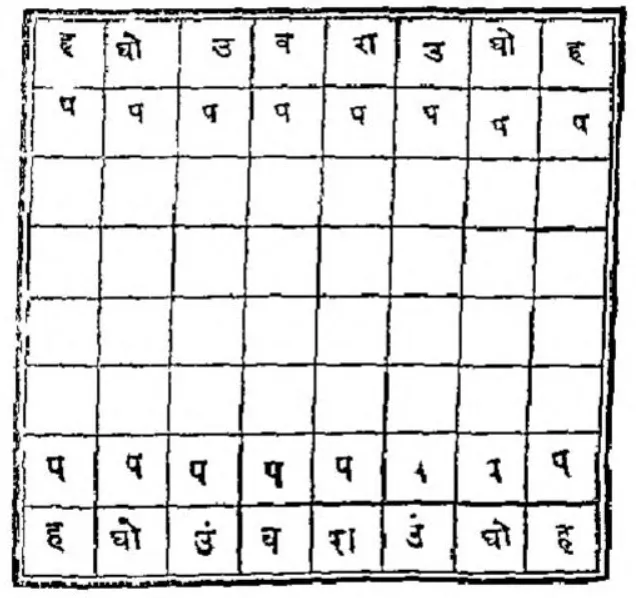
The Hindustani starting position as shown in the Vilas Mani Manjari (p. 48). Back rank: ह · धो · उं · व · रा · उं · धो · ह — structurally identical to modern chess, but with entirely different piece movements.
ShahMat is Persian. Chess players have been saying it for a thousand years and mostly don’t ask questions. Shah is the king; Mat is defeated, dead. Which is accurate, but it replaced something older.
The Sanskrit word for checkmate was Mati (माती) — from mṛta, dead. Not trapped, not cornered: the king declared dead. Before Shah arrived to rename check, it was Kaani (काणी). Neither word is hypothetical. Both are in a 1937 Marathi book from Kolhapur called the Vilas Mani Manjari.
Chaturanga Means Four-Limbed §
The introduction includes a detailed nomenclature table showing the Sanskrit names of every piece alongside their role in the ancient Indian army.1 The four limbs of Chaturanga were:
- Hastisena (हस्तिसेना) — elephant corps
- Ashvasena (अश्वसेना) — cavalry
- Rathasena (रथसेना) — chariot brigade
- Padatisena (पदातिसेना) — infantry
Each became a piece. The game was, from its inception, a war simulation. Laws and Practice of Chess is quoted directly in the introduction: “There can be no question that the Hindu game was, at some unrecorded period, converted by the Hindus themselves into the present game as it was presented when first introduced by them to the Arabs.”2
The text poses the question as a section heading: “‘Chaturanga’che ‘Buddhibal’ kele mhanje kay kele?” — “What exactly was done when Chaturanga was made into Buddhibal?”3 It then spends twenty pages answering it.
Why the Elephant Is a Camel §
This is the part that confuses readers. The book uses Hatti (हत्ती — elephant) and Unt (उंट — camel) for pieces, but these don’t correspond to what you’d expect from original Chaturanga. The image at the top shows why.
That starting position — Hatti (ह), Ghoda (धो), Unt (उं), Raja (रा), Wazir (व), Unt (उं), Ghoda (धो), Hatti (ह) — maps exactly to modern chess’s Rook, Knight, Bishop, King, Queen, Bishop, Knight, Rook. This is not the starting position of original Chaturanga. It’s the Hindustani chess tradition as it existed in Maharashtra in 1937.
The text explains it plainly on page 51:
“Haathi jasa sarala jato tasa Unt tirpa jato.” “Just as the elephant goes straight, the camel goes diagonally.”4
By the Hindustani period, the original Chaturanga Gaja — an elephant that jumped exactly two squares diagonally — had split into two separate pieces. The name “elephant” stayed, reassigned to the straight-moving piece (now a rook). The diagonal piece needed a new name. It became the Unt — the camel — because a camel’s lurching gait felt more diagonal than an elephant’s straight march.
The book does not conflate the two traditions. The introduction explicitly compares the Hindustani system (Desi) with the English system (Imji/Vailayat) and the ancient Sanskrit game — noting: no en passant in Hindustani, a different king-leap rule in place of castling, a different stalemate treatment.5 Unt refers to the Hindustani diagonal piece. The Sanskrit Gaja jumps two squares diagonally. Different pieces, different centuries, same game — documented across all three layers in the same book.
It also includes a genealogy table — “Buddhibalantil Shabdanchi Vanshaval” — tracing every piece name from Sanskrit through Marathi to English.6 The most striking row: Mati (माती) = Nirmuktī — not “trapped,” not “defeated” — dead. From mṛta. The king is declared dead.
The Return Journey §
The standard account runs: Chaturanga left India, became Shatranj in Persia, became chess in Europe. Clean, directional, westward. The Vilas Mani Manjari quietly contradicts this.
The Wazir is the first clue. In Sanskrit, the second piece is the Senapati (general) or Mantri (minister). In the Hindustani tradition this book documents, it is the Wazir — وزیر — a Persian and Arabic word, the vizier, the royal counsellor. That word did not descend from Sanskrit. It arrived from the other direction. Shatranj, which had absorbed Chaturanga’s structure and renamed its pieces in Persian and Arabic, eventually re-entered the Indian subcontinent — where it met surviving local traditions and merged with them. The Hindustani game is the result: structurally Indian, partially Persian in vocabulary, structurally close enough to European chess that 19th-century Kolhapur scholars could compare them line by line.
The Gambit is the second clue. The concept existed in the Indian tradition — sacrificing material for advantage — but the word the book uses is गॅम्बिट: 16th-century Italian, via Spanish gambito, via Arab intermediaries who had the idea from Persian chess. The Indian tradition absorbed the European word back for a concept it had always possessed.
The third clue is the stalemate ruling. The Nirnayacharyas — the scholarly council that adjudicated disputed positions — issued a verdict using the term Huijoret, which the text phonetically renders in Marathi. It appears to be a Persian or Arabic word. The Indian judicial vocabulary for a specifically Indian rule had borrowed its official term from the tradition that had borrowed the game in the first place.
What the book documents is not a clean inheritance. It is a system that went out, was transformed, came back transformed, and was documented at the point of re-synthesis — by scholars who were also tracking European chess developments in real time, comparing them explicitly with both the Hindustani and Sanskrit traditions. The genealogy table is not just etymology. It is a record of every contact point the game made on its way around the world and back.
The Words the Game Uses §
काणी (Kaani) — check. The pre-Persian Sanskrit word, predating Shah. The book shows both coexisting — Kaani and Shah — the exact moment Sanskrit and Persian vocabulary overlap in the same living tradition.7
माती (Mati) — checkmate. From mṛta, dead. Not trapped. Not defeated. The king is declared dead, not captured. This explains the bare-Raja rule: a king abandoned by his entire army hasn’t been checkmated — he has been left to die alone. Both conditions are a win because both are the same thing.7
कुजी / कुंठितवधम् (Kuji / Kunthitavadhama) — stalemate. Kunthitavadhama is Trivegadacharya’s Sanskrit term: the blunted killing. A death that cannot be completed. In Chaturanga, stalemate is a loss for the stalemated side — not a draw. A further authority, the Shumrapankshika (शुम्रपंक्षिका), is cited alongside Trivegadacharya on this point — a separate ancient Sanskrit chess text, still unrecovered.8
Three game phases:9
- मुरवती (Murvati) — the Opening. From muravat, meaning etiquette or protocol — a delicate beginning. Opening theory was entirely oral and undocumented. The text states plainly: “Murvatiyavar Ingreji pustake naahit. Aapan swatah abhyas karuya.” — “There are no English books on the opening. Let us study it ourselves.”10
- मध्य (Madhya) — the Middlegame.
- चिनी अवस्था (Chini Avastha) — the Endgame. What chini means in this context, we can only contemplate.
The Staunton quote in the introduction earns its place here. Writing in 1849, he observed that chess-playing in India had reached “a height of excellence which, if equalled in modern times, has never been surpassed.”11 The Vilas Mani Manjari’s editors quote it without irony, as evidence of something they are trying to preserve before it disappears.
Quick Reference §
Who wrote the Vilas Mani Manjari? §
The manuscript was discovered in 1928 by G.R.K. Haldikar of Kolhapur, found in private family collections. R. Kulkarni translated the Sanskrit into Marathi. Published 1937, Sri Dnyaneshwar Press, Kolhapur. Foreword by Dr. Bal Krishna, PhD. A second manuscript (Balak-Hit-Buddhibal Kridanam) discovered in 1936 references Laxman Pandit as an earlier authority. A partial English translation of some problems was printed by Mr. Cruz, Bombay, 1814 AD.
Who is Trivegadacharya? §
Trivegadacharya (त्रिवेगदाचार्य) is the ancient Sanskrit chess authority whose Shastra is the canonical source for the Vilas Mani Manjari’s problems. His work predates this 1937 publication by centuries. H.J.R. Murray references him in A History of Chess (1913) but could not fully reconstruct his system. The Vilas Mani Manjari is the most complete surviving commentary on his work.
Why does the book use Unt (Camel) instead of Gaja? §
The book documents Hindustani chess — an evolved tradition where the original Gaja (elephant, jumping two squares diagonally) had split into two pieces: the Hatti (elephant, moving straight = rook) and the Unt (camel, moving diagonally = bishop). The text documents both the Hindustani and ancient Sanskrit systems side by side. Unt = Hindustani diagonal piece. Gaja = original Sanskrit two-square jumper. The original Gaja is the piece this game implements.
What do Kaani and Mati mean? §
Kaani (काणी) is the pre-Persian Sanskrit word for check. Mati (माती) is checkmate — from mṛta, “dead.” Kuji or Kunthitavadhama is stalemate — “the blunted killing,” a loss in Chaturanga.
The Manuscript §
G.R.K. Haldikar found the manuscript in 1928 in private family collections in Kolhapur. R. Kulkarni translated the Sanskrit into Marathi. Sri Dnyaneshwar Press published it in 1937. The foreword was written by Dr. Bal Krishna, PhD, endorsed by Sahityacharya Tatyasaheb Kelkar. The Times of India noted the discovery on 28 July 1937.12
Eight years into the project, a second manuscript turned up — Balak-Hit-Buddhibal Kridanam, seven verses, referencing a lost treatise by one Laxman Pandit. The Vilas Mani Manjari cites Trivegadacharya constantly and with clear reverence as the canonical authority.13 Before either of them, Mr. Cruz had printed a partial English translation of some problems in Bombay in 1814 — which did not circulate widely.14
Sir William Jones (1790), Captain Cox, and Forbes had all argued from inference that chess originated in India. Trivegadacharya was referenced. Professor Ghosh collected thirty-two references to the game from Sanskrit works spanning three thousand years.15 None of it was primary evidence. The Vilas Mani Manjari was the first primary Sanskrit text on chess found in modern times. Given that, the Times of India note in 1937 was understated.
Source: Vilas Mani Manjari (विलासमणिमंजरी), translated by R. Kulkarni, Rajaram College, Kolhapur, 1937. Archive.org: in.ernet.dli.2015.406300
Footnotes
-
p. 32 — “संस्कृतातील प्रत्येक व यंत्रकाचे निदेश” ↩
-
p. 35 — “There can be no question that the Hindu game was…” ↩
-
p. 36 — “‘चतुरंग’चे ‘बुद्धिबळ’ केले म्हणजे काय केले?” ↩
-
p. 51 — “उंट:- हत्ती जसा सरळ जातो तसा उंट तिरपा जातो” ↩
-
p. 51 — “हिंदुस्थानी पद्धतीत फर्जीन व मारता मारता (en passent) असा नियम नाही” ↩
-
p. 26 — “बुद्धिबळांतील शब्दांची वंशावळ” ↩
-
p. 26 — piece genealogy table, rows 10–11 (काणीन/काणी/शाह → Check; निर्मुक्ती/माती → Mate) ↩ ↩2
-
p. 55 — “(प. बु. कलित मात ‘शुम्रपंक्षिका’…”; Kunthitavadhama attributed to Trivegadacharya ↩
-
p. 57 — “राजाचे, मुरवत (opening) मध्ये (middle) व अंत्य (end-games)”; “(पाच होण्यास गॅम्बिट-Gambit-देणे म्हणतात)” ↩
-
p. 59 — “मुरवतीवर इंग्रजी पुस्तके नाहीत. आपण स्वतः अभ्यास करूया” ↩
-
p. 24 — “The felicity displayed by Oriental players…” — Chess Player’s Companion, H. Staunton, p. 380 ↩
-
p. 3 — “Times of India, 28 July 1937 — Chess enthusiasts will be intrigued by the discovery of two Sanskrit manuscripts on the game, unearthed by Mr GR. K Haldikar of Kolhapur” ↩
-
p. 21 — “त्रिवेगदाचार्याच्या…” ↩
-
p. 8 — “Besides some of its problems were translated into English and printed by one Mr Cruz in 1814 AD at Bombay” ↩
-
p. 9 — “has collected as many as thirty-two references to this game under such names as Ashtapad, Chaturang and Budhibal” ↩